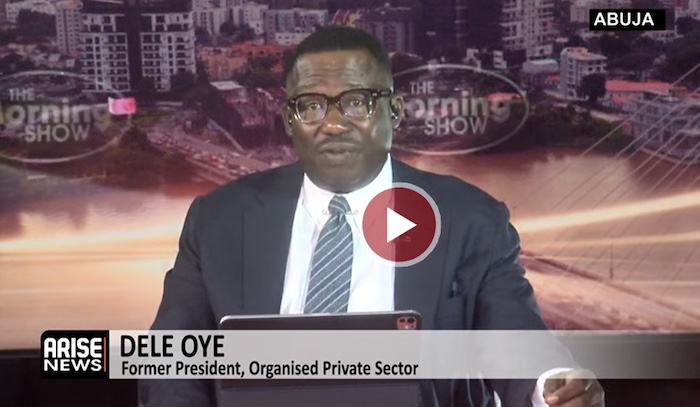
Dele Oye says Tinubu’s Turkey trip prioritised private sector partnerships, boosting investment confidence and strengthening Nigeria-Turkey trade ties.

Chairman of the Nigeria-Turkey Business Council, Dele Oye, has defended President Bola Tinubu’s recent visit to Turkey, describing it as a strategic economic engagement aimed at strengthening private sector collaboration rather than a political exercise.
Speaking on ARISE News on Tuesday, Oye dismissed criticism that the President’s foreign trips were excessive,
insisting the Turkey visit delivered tangible benefits for Nigeria’s economy.
“What we are saying is not a political visit. Government does not do business. The real intent of the whole is to bring the private sector in Nigeria with the private sector in Turkey. And that was fully achieved,” he said.
Oye explained that the Nigeria-Turkey Business Council was established through a joint venture involving Nigeria’s National Chamber of Commerce and the Turkish Ministry of Foreign Affairs, represented by DE?K. He said the council leveraged the President’s visit to organise a business forum alongside official engagements.
“It is not only the official aspect that happened, but also private businesses that were linked,” he said.
He revealed that trade between both countries is far larger than official figures suggest. “Unofficially, it is well over 10
billion,” Oye said, adding that Turkish products are present in homes across Nigeria.
According to him, the President’s visit helped recalibrate bilateral relations and reassure investors. “The signing of those MOUs and bilateral agreements will enhance our ability as private businesses to continue to do business with Turkey. And most importantly, to give the Turkish businesses the confidence at the highest level that their government is aware of their involvement in Nigeria,” he said.
Oye said there are currently about 44 well established Turkish companies operating in Nigeria across sectors including construction, manufacturing, power and aviation. He noted that Turkish construction firms alone have carried out projects worth billions of dollars in the country.
On concerns that Nigeria exports mainly raw materials while importing finished goods, Oye said efforts are underway to deepen industrial collaboration. “I don’t support any company coming to Nigeria to buy and sell. If you call me on that, I will not listen,” he said.
He stressed that Nigeria’s value lies in its market size and continental access. “Turkey has a huge industrial base. And Nigeria presents a gateway under the African Continental Free Trade to a 1.3 billion market,” Oye said.
Addressing visa challenges faced by Nigerians travelling to Turkey, he acknowledged the issue remains unresolved but said progress is being made. “We’re working very hard. With this level of cooperation and the agreement signed, I think that issue will be resolved,” he said.
Oye also admitted that the balance of trade currently favours Turkey but blamed poor data collection for the lack of clear figures. “It’s very difficult for you to put a figure on it. The reason is because most of our businesses, and the data we have are not reliable,” he said.
He disclosed that more than 20 Nigerian companies registered with the council are operating in Turkey, although many investments are not publicly documented. “There are a lot of Nigerians building hotels and various resorts in Turkey. These are not captured in this business,” he said.
On lessons Nigeria can learn from Turkey, Oye pointed to strong institutional frameworks. “Turkey has an institutional framework for dealing with foreign direct investments,” he said, adding that Nigeria must improve how it structures and tracks foreign trade agreements.
He also highlighted opportunities for Nigerian businesses, especially SMEs. “Turkey is the biggest consumer for SMEs,” Oye said, citing agro processing, tourism, fashion and creative industries as key growth areas.
Oye maintained that the President’s visit has opened the door for deeper industrial cooperation and future investments, insisting the engagement was driven by economic value rather than politics.





![2026 Ballon d’Or: Top 4 ranking for October [Full List]](/_next/image?url=%2Fapi%2Fimage-proxy%3Furl%3Dhttps%253A%252F%252Fdailypost.ng%252Fwp-content%252Fuploads%252F2025%252F08%252Fballon-dor.jpg&w=256&q=75)